
(Adapted and reprinted from Our Lives in Nature)
On a late November walk, a young friend and I found several golden orange jack o’ lanterns in the woods, though it had been a month since Halloween. There were no carved faces, just smooth clumps of orange. Logan was delighted to find all these mushrooms, just as he was with all the mosses growing in the woodlands. And I was, in turn, delighted to watch his excited discovery of these small wonders.
The “southern jack o’ lantern” is a large mushroom that grows from wood, often in clusters at a fallen tree limb or at the base of a tree. They’re common from summer through autumn at Sheri Capehart Nature Preserve. It has been very dry from late summer through much of autumn, but now that rains have come, orange mushrooms are popping up.
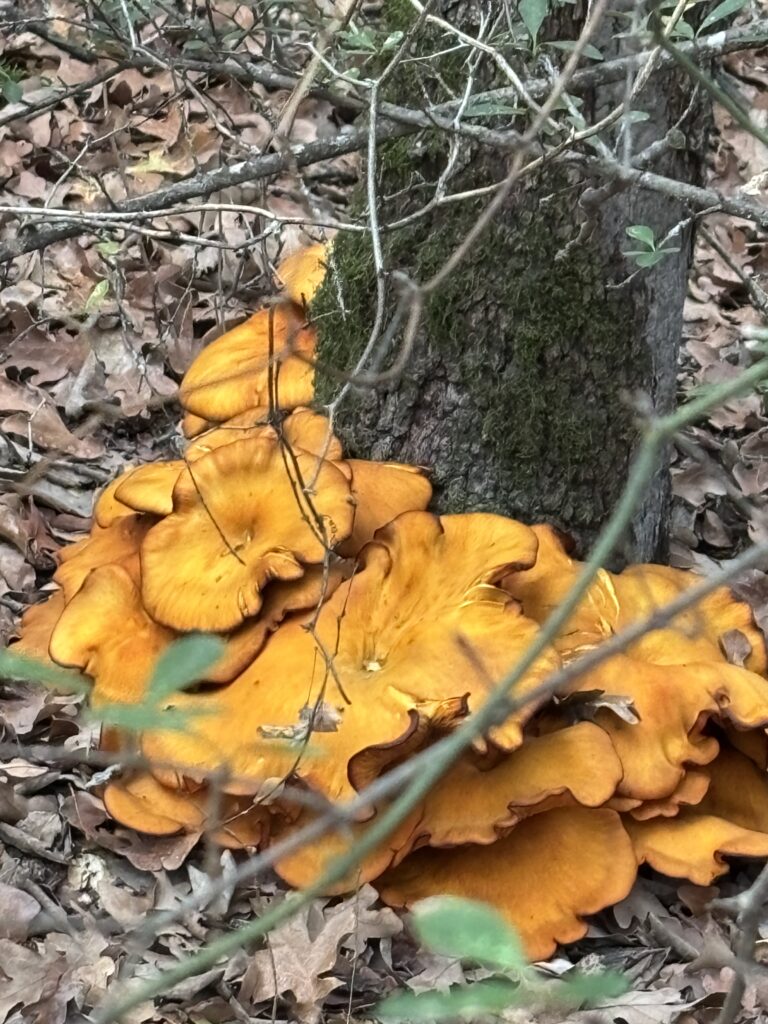
A Missouri Department of Conservation website says that the southern jack o’ lantern is bioluminescent, so that “the gills of fresh specimens may sometimes give off a faint greenish glow at night or in a darkened room.” It would be fun to return at night and see if we could observe that.
We are used to seeing a plant or animal that we can point to, whose body or structure is gathered together in one place as one “thing.” However, with fungi it’s more complicated. For much of the year, the jack o’ lantern is a network of tiny filaments and threads running through soil and decaying wood – the mycelium. If I said, “show me a jack o’ lantern,” you would have to dig in the soil or turn over a rotting log to find those little fungal threads and say, “well, there’s some of it.” The mushroom itself is just the reproductive structure, producing spores that are almost (not quite) like seeds that will grow tissues that will become a new fungus. So a mushroom is a little like a flower – the part that catches our attention but is only the reproductive part of a larger organism.
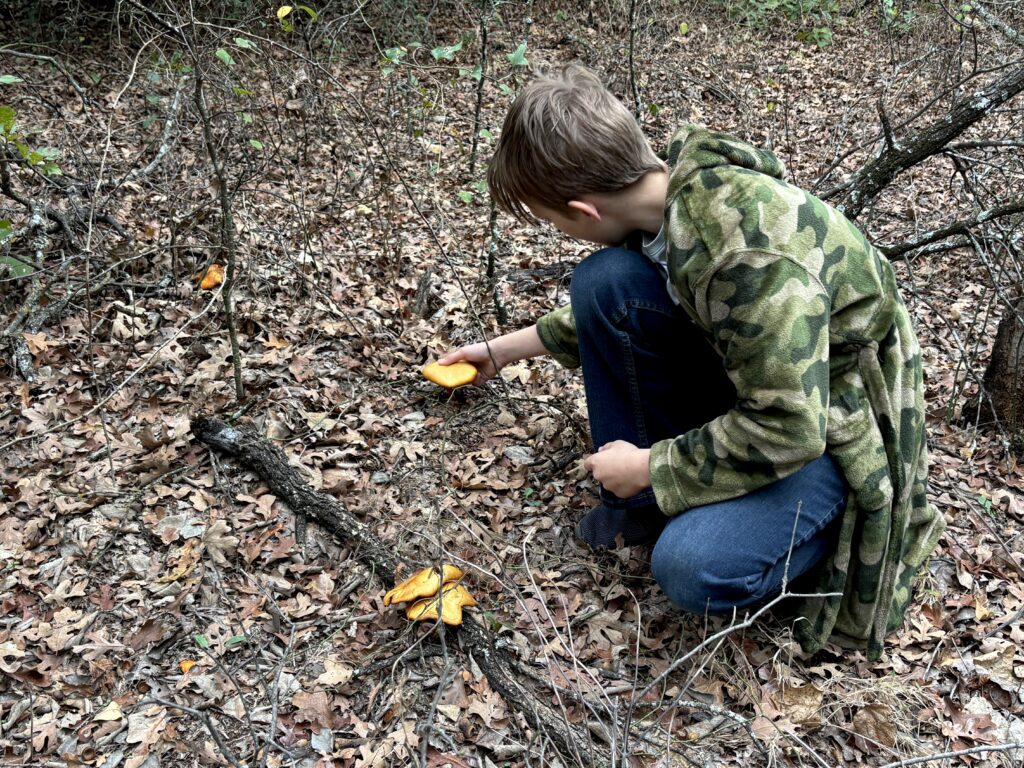
Logan wanted to know if it was edible, so I looked it up using iNaturalist and found that it is poisonous. Not like a death cap mushroom that might be fatal, but the jack o’ lantern would give you the sort of upset stomach that one website said might “make you wish you were dead.” Definitely a mushroom to admire and leave just where it is.
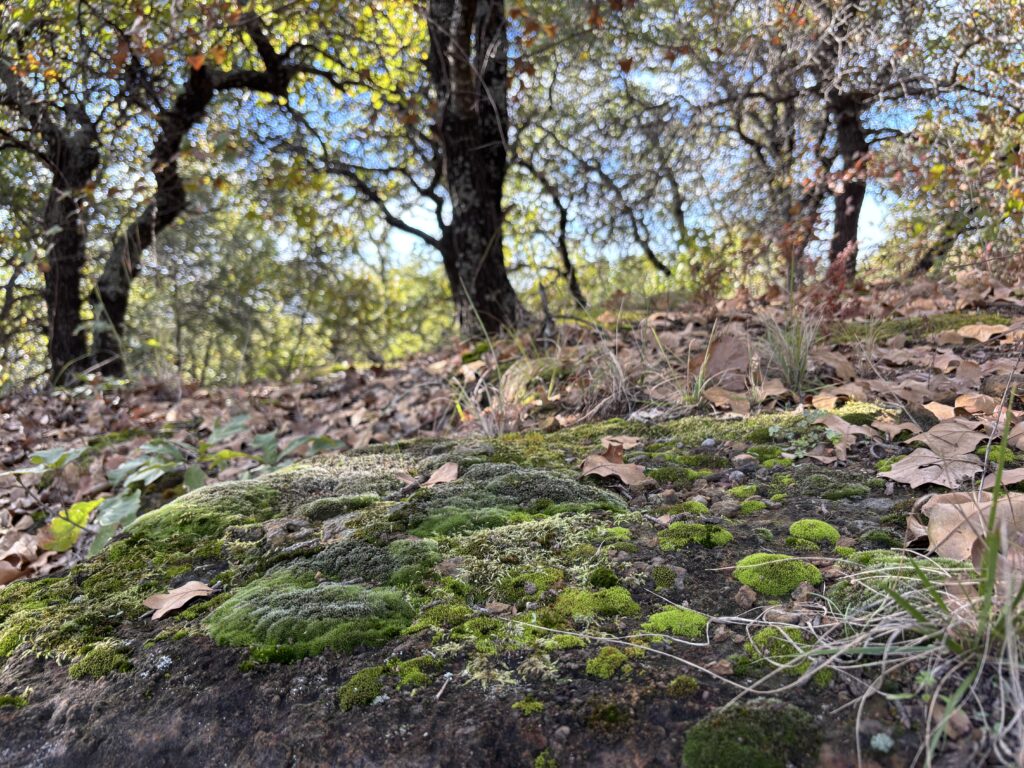
The other thing that really captured Logan’s imagination were the mosses. These little soft, green mounds growing along the ground in protected places can bring many of us into miniature worlds, sitting beside a butterfly and drinking from an acorn cup. They are plants, but without true roots and without the little tubes (vascular tissue) that flowers and trees use to move fluid and sap around. And so they must grow in short, compact mats or mounds. In shady places, an oak tree may grow a garden of moss along one of its bigger branches or at the base of the trunk. At the preserve, the sandstone at the bluff can also provide good growing conditions. The porous rock can hold moisture and is easy for moss to anchor itself to.
Mosses can survive periods of drought to an amazing degree, seeming to spring back to life after a rain. At the top of the preserve there are many partially-shaded places where mosses grow. In the heat of summer, especially when it is quite dry, they become dark green crusts along the rocks, waiting for rain. Then, the plant’s cells fill with fluid and they become green and springy.
Another small growing thing that can produce a sort of miniature garden is lichen. Dead oak branches provide a great substrate for lichen to grow, either as the greenish- or bluish-gray foliose lichens that cover the surface in a ruffled coating, or else as little shrub-like fruticose lichens. One of the latter, the golden-eye lichen, is a favorite of mine.
Lichens are not plants. They are partnerships between two things. Not just a fungus, and not just an alga, but the two things fused together (or sometimes a fungus and a cyanobacterium). The fungus provides a structure and anchors the partners to a rock, a branch of wood, or other suitable place. The algae provide a means to manufacture food via photosynthesis. Together, they can survive sun, drought, freezing, and keep on going.
Regardless of the biological details, these living things add wonder to a walk in the woods. To pause and get on the same level as a moss or mushroom shifts our focus from the everyday world down to a small scale and we see everything in new ways. The details of leaves and the texture of moss, or drops of dew like tiny crystal orbs on the strands of a spider’s web, these things can transport our imagination to new places. It was wonderful to watch Logan find each new patch of moss and each new mushroom with that sense of delight. It was a little like what I see when I take my granddaughter to such places; the emotion and fascination isn’t tied to a particular age (you might see it in me if we took a walk together).
Experiencing nature in this way with children is just the best. It can be a window back into our own childhood, or the childhood we would wish for our younger selves or for others. It is also a hopeful sign for our future, that children can still find magic and connection in nature. And if they carry that forward, we might protect wild places and heal some of the Earth’s hurts.

A few days later, our area felt a bit of cold and a first morning freeze (barely, in some places). And it was now December; in the “meteorological” way of tracking seasons, winter starts on December 1st. Most of us use the winter solstice, December 21st this year, as the boundary between autumn and winter, but North Texas is at least hearing a few rumors of the winter to come. And that calls for a walk somewhere, putting our ear to the ground to listen.
I walked eastward along the “yellow” trail near the big pond and then turned and walked up through a tangle of woods to the “blue loop” and back toward the boulders. It was 63 degrees, a jacket needed only when the breeze blew. The place was full of sun and damp sand, native grasses going dormant and a coolness that balanced the sun perfectly.
In my journal I wrote “Phenology Note” on a sketched calendar page and made a few notes about the trees and leaves. “The trees are still mostly leafed out and green. Many oak leaves are tinged with caramel …. Some trees look ragged but we’re still waiting for autumn color and/or leaf drop.” Back near the parking lot, many of the cedar elm trees are becoming bare, but the oaks seemed barely touched by autumn.
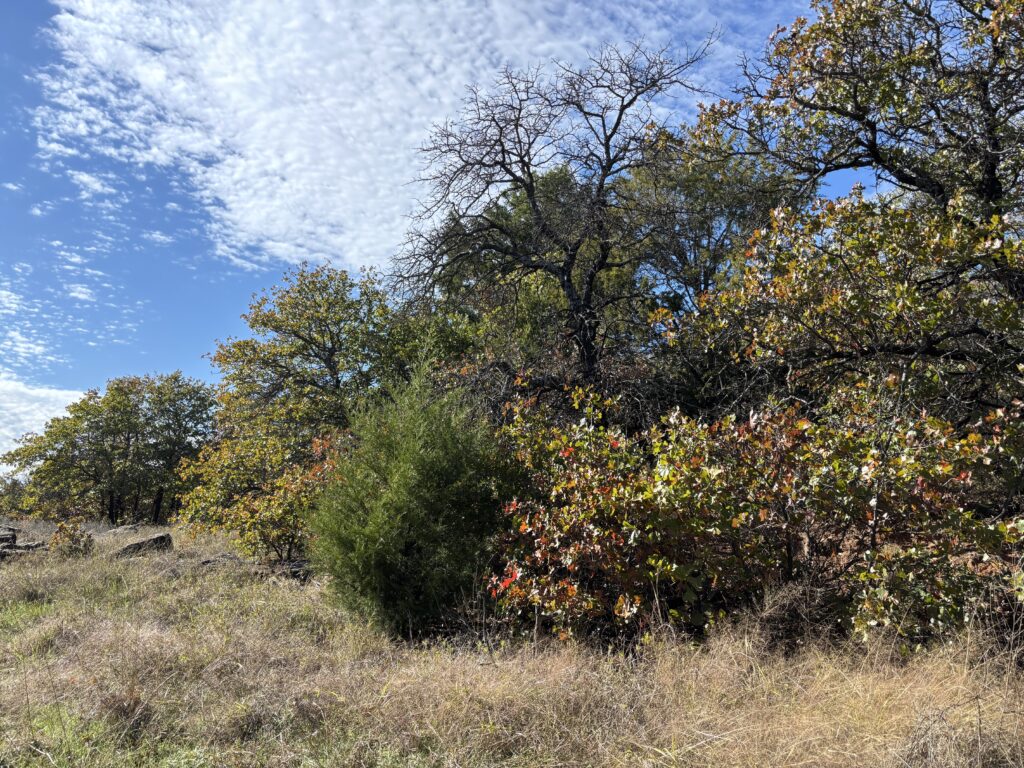
Phenology is the study of seasonal events in nature, and so looking back through a nature journal can show how the seasons change from year to year in a place. What’s the average time when trees lose their leaves, and how much is climate change pushing such events to new places on the calendar?
Using a journal in that way puts me in the mode of science and data, my thoughts separated from emotions about climate change as if severed by a scalpel. But journaling can – and I think should – be more than intellectualizing. On a good day I’ll make room in those pages for what I miss from a time when life was anchored by things you could count on. Winters could be hard or they could be mild; summers might vary in how hot or dry they got; but after whatever variation in the weather, we always returned to an arithmetic mean, an average that we all recognized as something we could depend on. But now the math isn’t our friend, and the arithmetic mean is shifting upward and we don’t know what we can count on.
I kept walking, looking and listening for wildlife. A one-minute sample using the Merlin app detected no sounds of birds. I did find a delightful grasshopper resting on a leaf turned nicely red. Uploading a photo to the nature app iNaturalist, the insect was identified as a “mischievous bird grasshopper.”
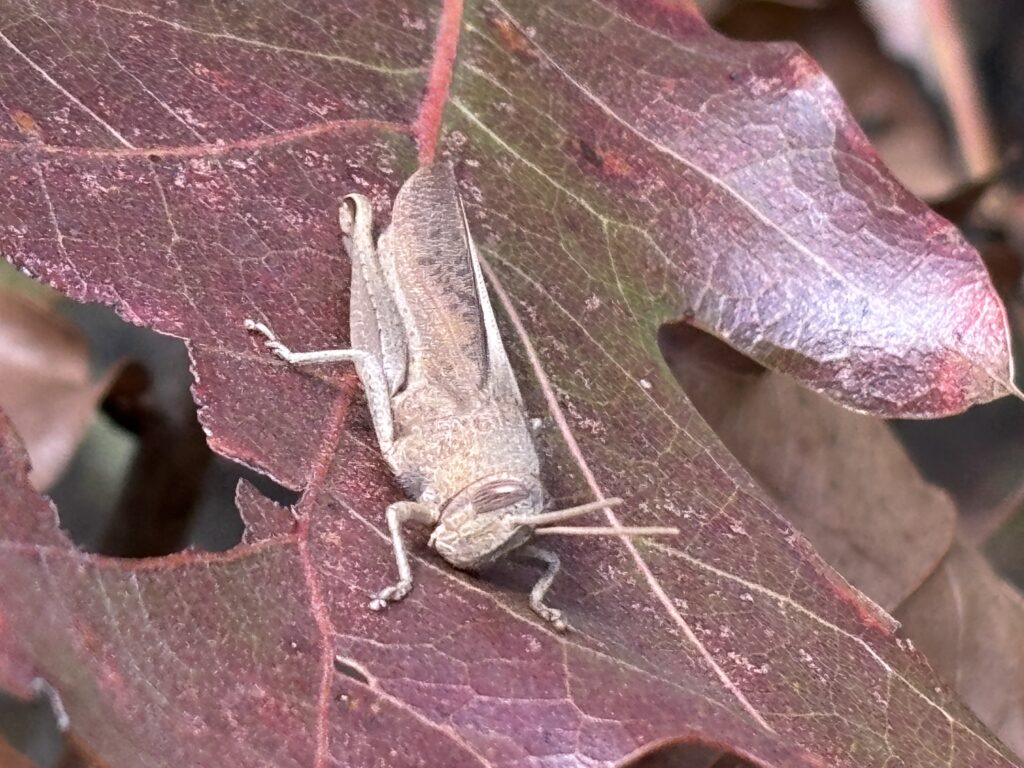
Now this was a find – what kind of mischief does this sort of grasshopper get into? This particular one was sitting motionless, perhaps too cool for tomfoolery and just feeling lucky to have survived yesterday’s freeze. Grasshoppers often don’t survive winter except as eggs deposited in some protected spot, although with increasingly mild winters, more adults like this one might get lucky.
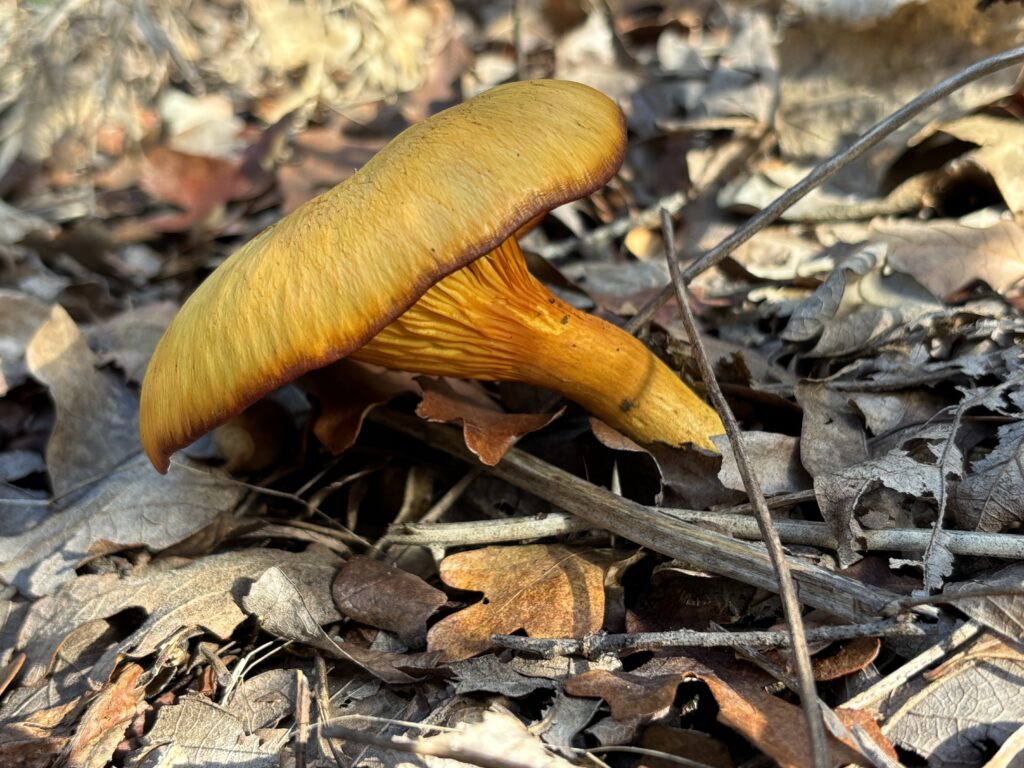
I wanted to follow up on the walk with Logan a few days ago in which we saw southern jack o’ lantern mushrooms. In the particular spot we visited, mushrooms were still there. It might be some combination of the right soil, shade, and moisture, but that place stood out with all those mushrooms. There was even a new one of a different sort. According to iNaturalist, it was a type of puffball mushroom. I want to go back to see if it matures to rupture and release a tiny cloud of spores.
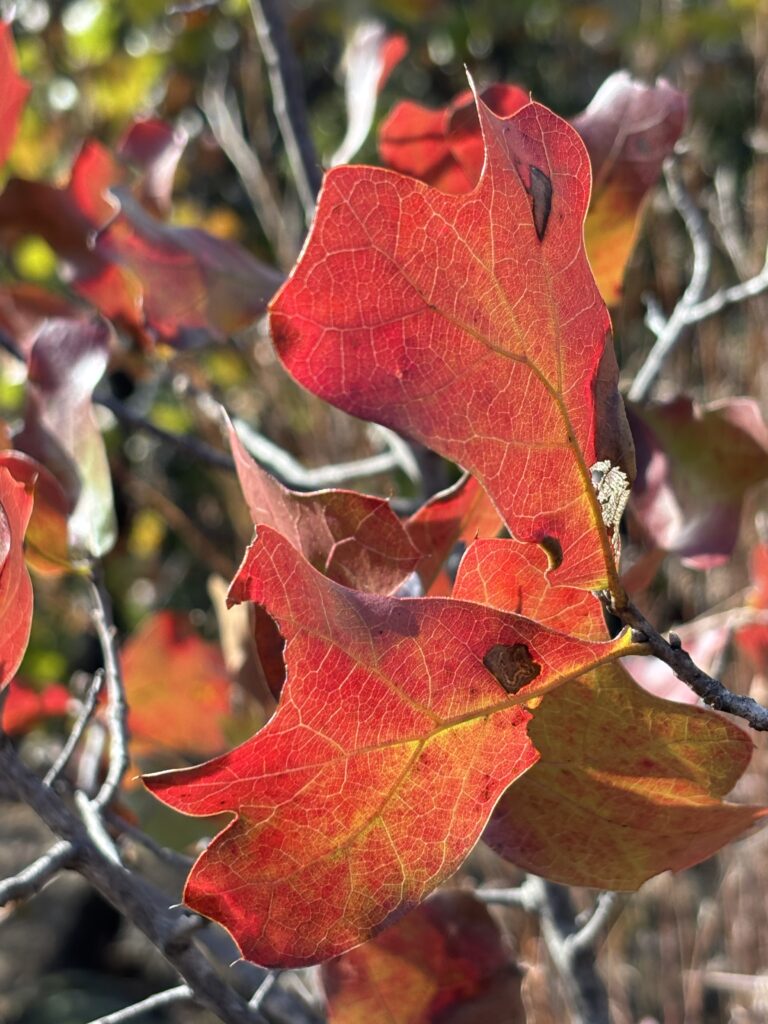
Even without a lot of fall color, there were places where the bright, slanting December sunlight backlit a group of leaves and created a dramatic display of color. Going slow, we can notice so many small and wonderful things.
And that includes the mosses. After the way Logan brightened with every new patch of moss he found, I was attuned to them today and really appreciated how they grow on the sandstone up at the bluff. Looking at some boulders was like seeing a miniature topography of meadows and hills.
I also noticed, on the way down the hillside, that the bee tree is active again (there were no bees visible on that cool and cloudy November 29th). I stood for a moment, imagining the extent of the hollow space within that tree, and all the honeycomb built within the spaces, and all that honey!
Pingback: The Solstice and the Leaves – Friends of Sheri Capehart Nature Preserve