
We are getting into late winter, and it feels like the season is on fast-forward. These warm days may add to that perception, for how can it still be winter if it’s 80 degrees outside? (Weather Underground reported a high of 85 degrees on the 9th.) Although I wish we had the climate of my childhood in the 1960s, these unnaturally warm winter days are a delight for walking around at the preserve and elsewhere.
The big pond is a good place to see the ducks and geese at the preserve. Lots of people use it as a fishing spot. I like to be able to watch fish going about their business, and so I scan the edge of the pond for western mosquitofish. We call just about any fish this size a “minnow,” but mosquitofish are live-bearing species in a family that aren’t truly minnows. They are around 1.5 inches long, and they’re known for eating small prey such as mosquito larvae along the surface of the water. And what an appetite! A fact sheet at the US Geological Survey (USGS) reports that they can eat as much as 42-167% of their body weight every day. However, don’t think that all this predation is focused on mosquito larvae, because mosquitofish eat zooplankton (tiny animals found in the water), small insects, and other prey. Thinking that mosquitofish would be an effective, non-pesticide control for mosquitos, people have introduced them in lots of places where they are non-native, and they often flourish. In these places, they may outcompete some native fish and harm ecosystems in other ways. This fish is native to Texas.
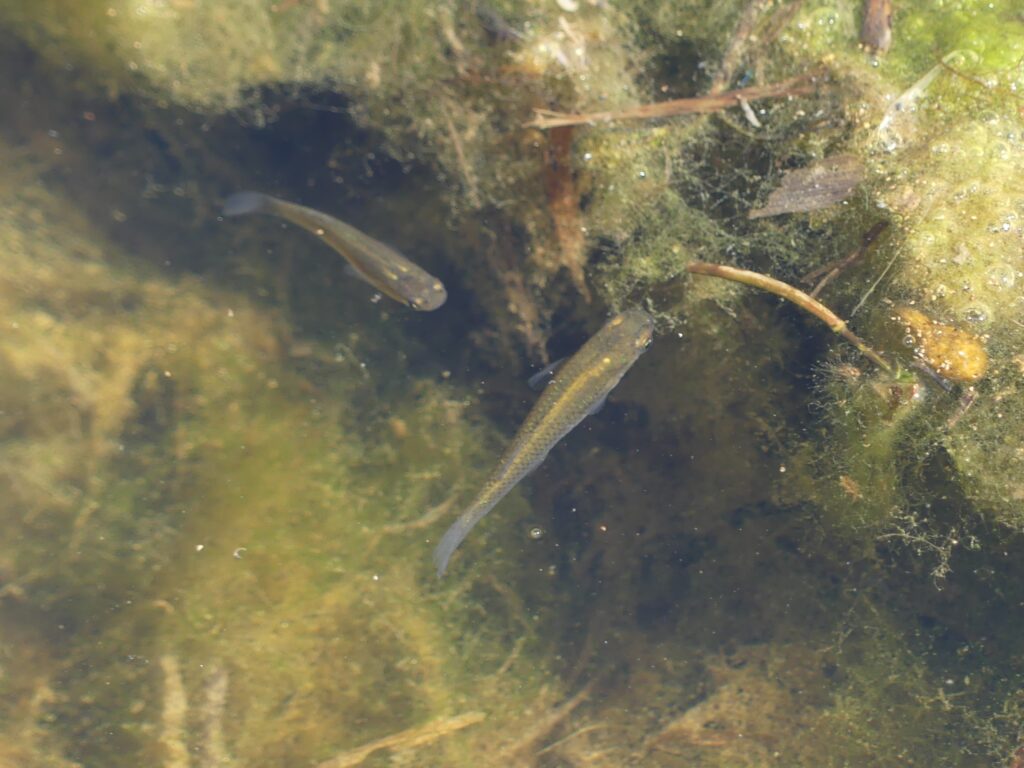
I remember catching mosquitofish in just about any pond or creek I could find near my home, and I loved how they were nearly translucent and how, at the right angle, their bodies reflected a kind of iridescent blue. I bristled a little to read, at the USGS site, that they are “dull grey or brown in color.” A little respect, please, for a fish that is, well, kind of unremarkable in color, but for a kid looking at those glints of blue they may be beautiful. Sort of.
Meanwhile, the pond’s surface was busy with birds. Some were too far away for me to get a good photo or identification, and some were so busy dabbling that a photo would have captured nothing but tail feathers. One duck, however, cruised along where I could get a pretty good look. Her most notable feature was a white ring around her bill, but when I looked her up, I found that she was a ring-necked duck. Apparently the early naturalists that named this duck were taken with a chestnut-colored ring around its neck. Males have a very dark head and neck, with light eyes. Females have brown heads and dark eyes. All of them have feathers on the crown of the head that often stick up a little, making the head look bigger.
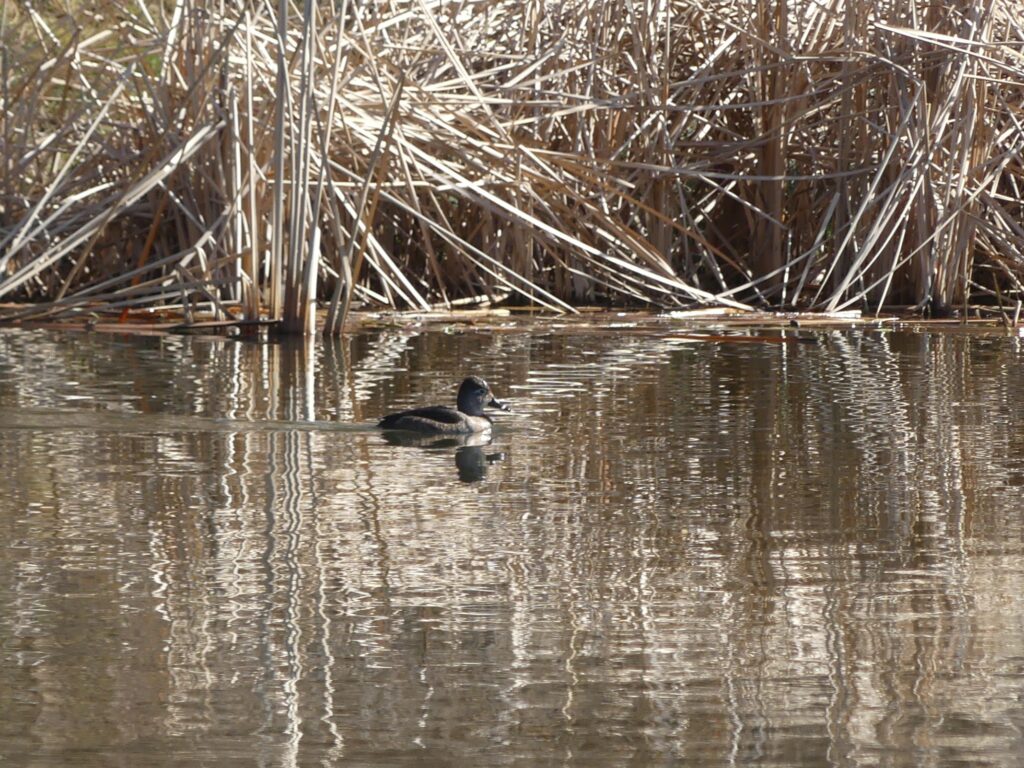
They dive to find food, meaning that the whole duck will disappear into the water rather than just going tail-up while sifting through the goodies. Ring-necked ducks go deeper, and may eat vegetation or else insects, snails, or worms. They’re here in winter but migrate to the northern states and Canada for breeding. I want to refer you to the Cornell Lab’s All About Birds website for more information. For those of us who are not veteran birders, this site is a treasure. It has photos, audio recordings of calls, and lots of natural history information. (And if I got any information about this duck wrong, it’s my mistake and not Cornell’s.)
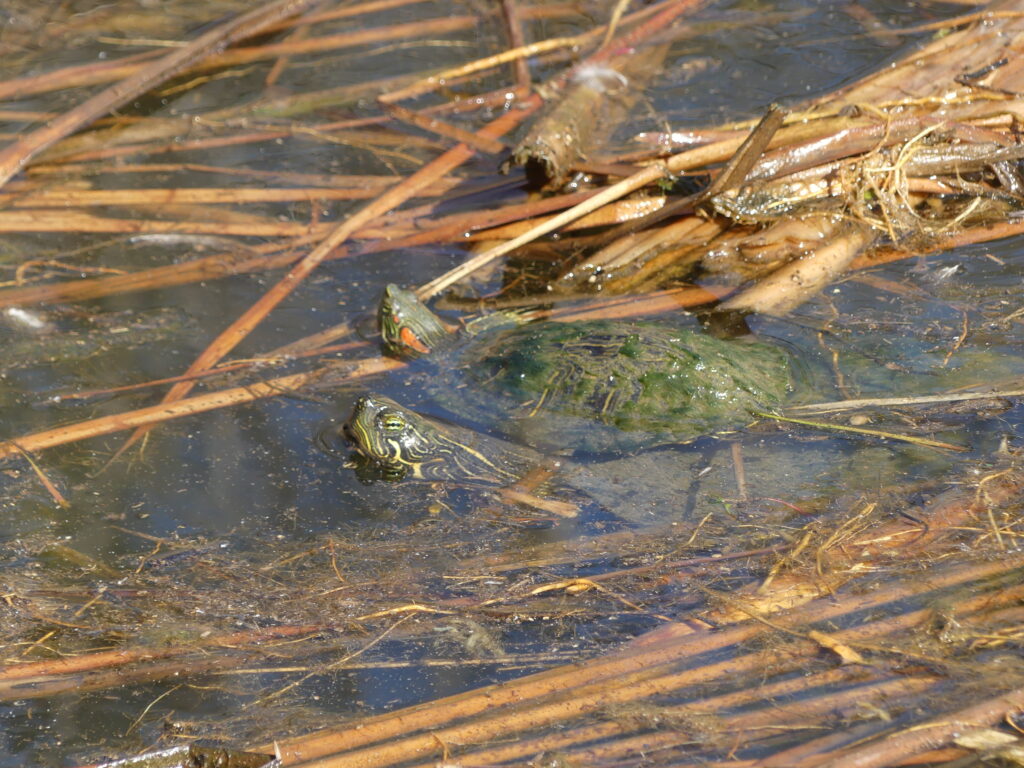
A few cricket frogs were stationed at the water’s edge at the pond, and in a shallow spot there were a couple of turtles. The smaller was a red-eared slider and the larger was a cooter with a head covered with beautiful yellow lines and squiggles. We have a couple of kinds of cooters in our area, the Texas cooter and the eastern river cooter. My friends at Texas Turtles said this might have been genetically a bit of both.
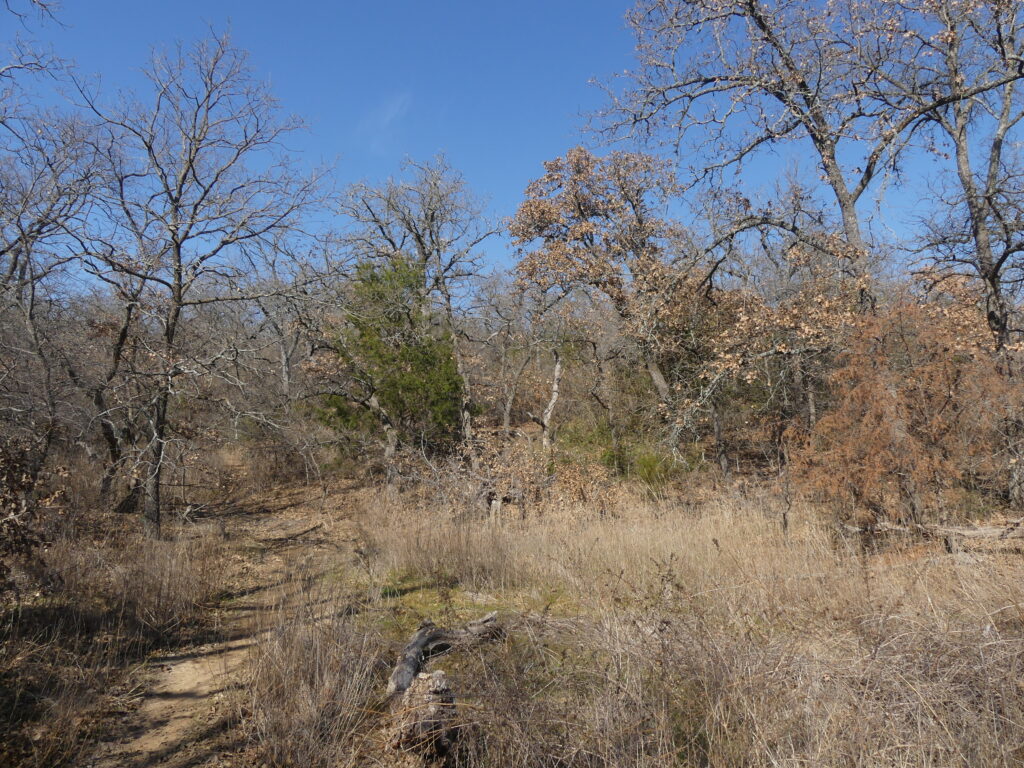
I followed the yellow trail up to the blue trail that loops around the hill, from the bluff around to the Caddo oak on the north side. I found places to rest and write in my journal, and also to watch the yellow butterflies – presumably sulphurs – that are fluttering madly all around the preserve. I followed one, now head high, flying through the juniper and bare oak branches, and now dropping down only inches from the ground and dodging greenbrier and leaf litter. Have you sat and watched them? They could seem so haphazard and crazy, but I’ve never seen one collide with anything. But if I was a predator, how could I catch something whose flight seems so impossible to follow?
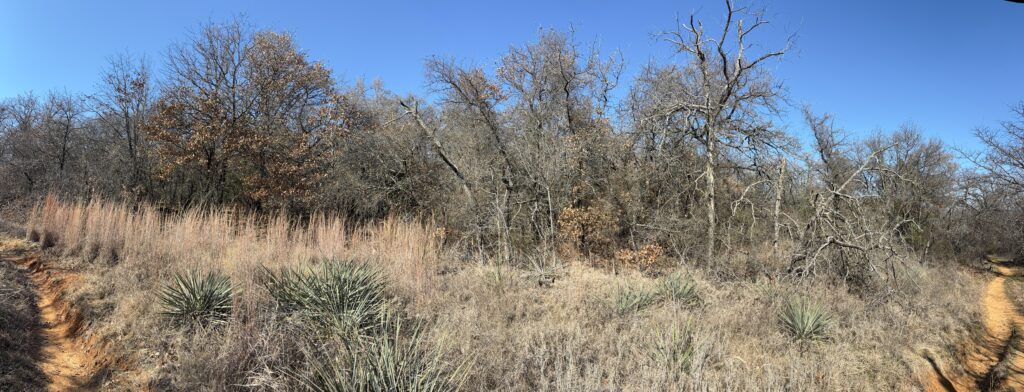
I also stopped to admire that patch of little bluestem grass and Glen Rose yuccas along the blue trail near the boulders. There are several places in the preserve to see this plant, known only from a few counties in North Central Texas and therefore its continued existence depends on preserves like this one.
Thinking about how much I saw in a little under two hours, how much would I experience in 4? How about 6 hours? With plenty of stops for rest, water, and the occasional snack. I used to work eight hours every day, so five or six hours in demi-paradise ought to be a real joy. What do you say? Who’s in?